Saturday, June 11, 2022

Kayak trip on the west coast of Vancouver Island

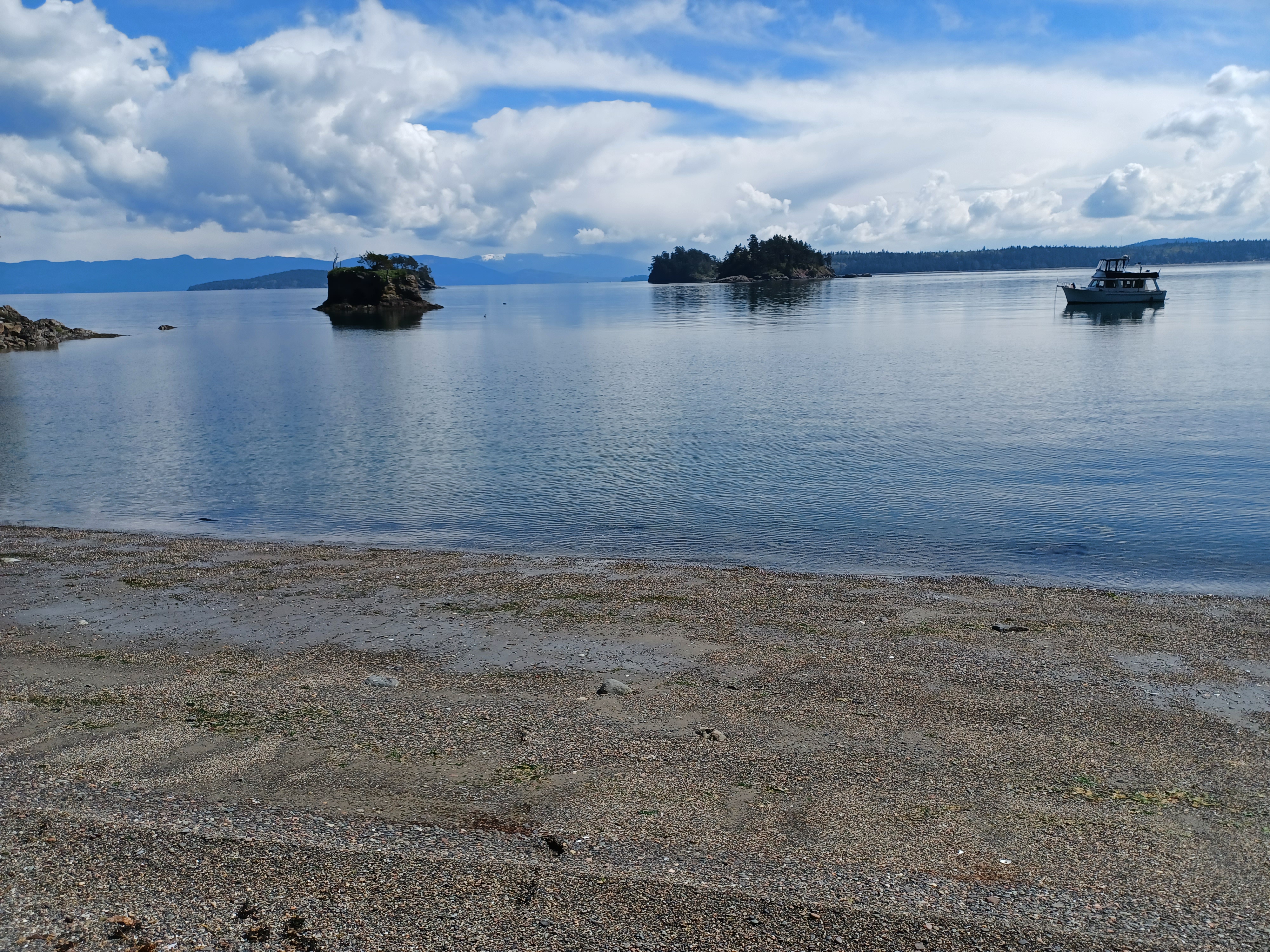
I just got back from a very cool kayak trip leaving from Tofino, BC.  Its on the west side of Vancouver Island, in Canada.  So I had to get to Canada, then take a ferry, then meet up with my friend Lindsey and then drive across Vancouver Island to get to Tofino, then get into little skinny kayaks and go out on the cold and wavy waters.  Here's a shot of the launching.


It was forecast to be a rainy time, and, as usual, the forecasters were inaccurate in their crystal ball gazing.  In fact, it was exceptionally rainy.  We had hopes for a day of sunshine, but the gods were displeased with our supplicants, I guess, so they delivered only a few hours of warm golden rays before they moistened us again.  The first evening we got over to Vargas Island and found a small beach to camp at, and in the fading light we paddled over to a small shallow bay and found small and shallow fish schooling around.  The fish became startled as we paddled by and reacted by jumping out of the water, almost as if they were piranhas.  I had one get stuck on my boat, and I think it was a form of sea perch.  Maybe the babies live in the shallows before they go out to sea.

There was a small river at the back, and its very similar to small rivers up in Alaska, with the same brown tannic acid water, and similar grasses and sedges.  
When we got out to camp there were some wolf tracks on the beach that had probably come from the middle of the day, so fairly recently.  
The next day we started out again and I found this fern just before we left, and I thought it might be of the genus Polypodium, but its not a licorice fern (which I believe is polypodium glycorizo... or something)  (ok, looked it up and its glycyrrhiza)  This one seems to be Scouleri.  
And so off we went.  The boat I was paddling was pretty narrow for me, but had a bit of rocker and was made of plastic.  A Necky Chatham 17.  I thought it was nice, and I really like the plastic boat so I can just drag it up on rocks, but it took me a bit to get used to how tippy it was, and I had a big dry bag of stuff up on top which didn't help that.  Lindsey was in a fiberglass boat with a long "keel" and it was really fast and good in flat water, but she said it was really tippy when the waves were bumpy or going downwind.  
There's lots of kelp we paddled through, and I noticed lots of Sea Otters that will help the kelp forests to grow by eating off the things that eat kelp.  There were two kinds of kelp that I saw mostly, the Bull Kelp and the Giant Kelp.  I am not sure what is the deciding difference for where each wants to grow, but the Giant kelp is found all the way down to California and only in a few places in Alaska, whereas the Bull Kelp I have found more in further north (and colder) places.  Both like the open sea and don't seem to like being near a river.  

We did a long distance this day, and stopped for a snack at a beach with a broken down old wreck.  I think this boat might have been washed ashore and then burned on the shoreline afterwards, but it could have been the reverse and the fire caused people to abandon ship and it washed ashore with flames.  But ships that burn usually burn fast and don't have time to go anywhere, so I am still sticking with my idea it caught fire on the beach.
Another beached craft, but this one not yet aflame...  After a long day of paddling towards a little camp symbol of the map that we were using as our guide, we dragged ourselves up onto this barren stone mound to find a place to camp.  It was mostly basalt kind of rock, so lava, but there must have been a lot of soluble materials in the rock because after the glaciers came through and smoothed it all over into nearly perfect smooth bumps, the ocean (or rain) tore great sharp chunks out of the rock all over it.  So finding a place for a tent was looking very grim.  Our Malevolent Mapmakers (or cantankerous cartographers) who drew such hopeful little camp symbols on this spot had lied to us!  We scoured over the Batholith of back pain and finally found a tiny spot to put a tent, and there we spent the night.
It had been a long day of paddling in the rain and wind so our hands were made of raisins and prunes.  
The next day we had a spot of sunshine.  We hung up everything to dry and set off in enlightened kayaks to the back bay of the fjord we had found ourselves in.  A small stream comes down from the hills and makes a flat at the bottom, so we strolled around in the grass and a little into the woods.  A very un-constipated bear lived there.  
We crossed the river a bit
And climbed up on a log for a view of the river, and for lunch.
The beautiful day quickly became overcast, and, fearing storms ahead, we began our backtracking towards Tofino.  We collected our stuff from the Bivouac of broken backs and made our way along the shoreline.  As we passed a river outlet I heard a waterfall, so we pulled into the river to look.  
It was very hidden.  There was a giant tide flat that we navigated up and then huge cliffs rose out from the shallows and a very small canyon emerged.
and the canyon was passible in a kayak, so we found a very cool waterfall cascading into it.
Another view of the falls
The tide flat was from multiple rivers, so we continued on a short distance to a place that showed promise for camping (but wasn't listed as such by the map-makers) and found a beautiful stream with grassy patches on all sides and very flat soft dirt and grass to set a tent up on.  A perfect spot!  But there was one catch...  It was already occupied!  As we came into the river we spotted a black bear munching on grass.  We watched for about 30 minutes and the bear didn't seem to be bothered by us at all, just sniffed a bit and turned his but in our direction, but didn't run off.  So this was a good sign, that it wasn't bothered by us, and not curious, but at the same time, maybe this bear would bother us in the night?  We were trying to decide it finding another spot was a better idea or not, so we went further up the river...
And then we spotted a wolf!  It was right on the river bank and stood up and looked at us before loping off a short distance and sitting down.  The bear was a signal to go away, but the wolf was telling us we should stay!  Have you ever camped near a wolf?  I had not, and was very eager to.  So we decided to risk it.  
We set up camp on a nice little finger of higher ground where we figured the bears wouldn't really want to wander over, and also did our cooking and cleaning a long ways away from the tent.  There were nice flowers all over.
The Paintbrush (red) and the Chocolate Lilly (brown) were up and looking great.
It began to rain on us a little, and we explored a bit before bedtime, but the wolf came back to the spot just across the river from us and we found it was a kill.  It was a dead animal and so we sat in the tent watching the wolf eat for some time that evening.
The next day we got moving pretty early because we were concerned about getting back before a big weather system, so we popped across the river to look at the kill.  We had figured it was a deer, but in fact, it was a bear!  I don't know what killed it, but the fur was all gone and the skin of a bear looks a lot like a werewolf foot from the movies.  Also it smelled bad.
Here's a wider shot of the foot and the rest of the bones and Lindsey holding her nose.  
So we paddled out and as we left we found the bear from the evening before just eating grass some more.
It was a long paddle and we were against the wind the whole time and there was also a lot of rain.  We stopped a few times to rest and once got out of the boats for lunch at a beach with giant mussels.
It was near an opening to the ocean and so the beach was well formed, but the waves weren't too big for us to handle going ashore.
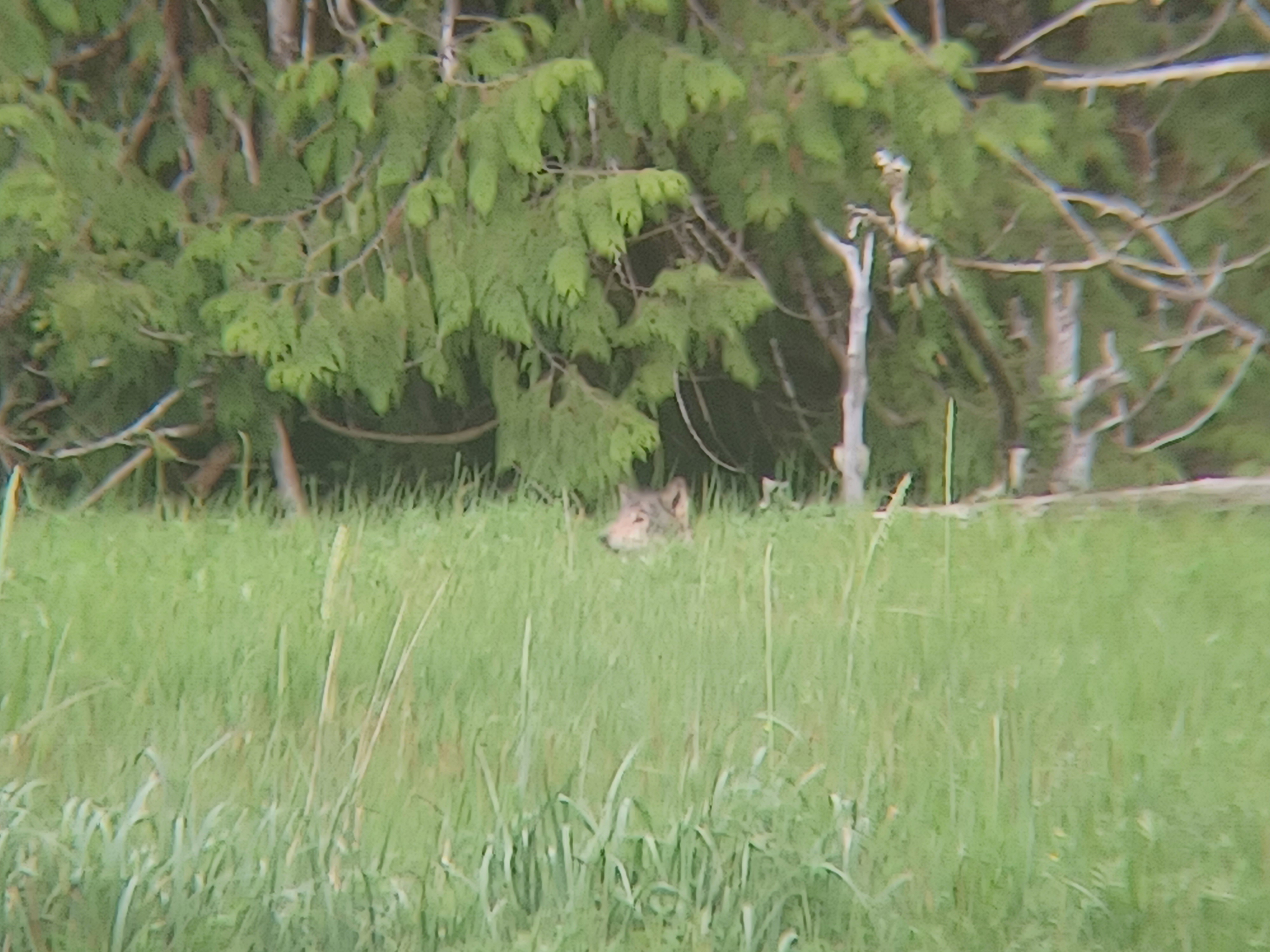
After a lot more slogging along we neared Tofino and found another wolf scouring the shoreline for something to eat.  Its the whiter blob in the middle here.

I got a short video of the wolf coming out to look at me and then going away again...


We got back to Tofino and camped in the rain at a small off the road spot in the woods and then headed back to Nanaimo.  On the way we stopped at an Old Growth Forest spot and got out for a look in the rain.  I don't know what this is, but it looks a lot like rattlesnake plantain in the leaf coloration.

And there were big trees with maiden hair ferns nearby.   It was very pretty.

The trip was a lot of fun, and I learned a lot about the area up there.  I think I'd like to go again with a bigger boat or have more time, or just not get rained on so much.  It was very different from my canoe trips, since we could go much faster in bigger seas and against the wind better, but we were very limited in stuff to bring with, and also we didn't have that much time to really be out in the wild.  It took a long time to get beyond the reach of all the people that live in boat accessible houses near Tofino, so there was a lot of boat traffic for a long time.  It was only in the back bay area that we didn't see any sign of humans for a full day.  

I have one more week left before I go back to work, and I'm planning on a trip with Gran Milonga and Abe, Katrina, Forrest, Rachel, Henry and Nora.  It should be fun!
 

Friday, April 15, 2022

Springtime migration north!


I'm back in the USA now!  I finished up my wintertime freedom and put Aquila away, and then flew over to La Paz to work on the Safari Voyager for two weeks in the beautiful Sea of Cortez.  After that, I flew up to Bellingham and then quickly got aboard the Gran Milonga and went out for a short trip in the San Juan Islands.  I started out with Lummi island, a favorite of mine, where I spent a few nights and had a nice walk around.  There are lots of fresh growing flowers and plants and migratory birds travelling through to look at.  I found some Fawn Lillies.

And another shot of the nice little bay...


Every year on my northbound trips I rediscover the wonders of my homeland, and I really love the bark and colors of the Madrone.  

Upon hiking up to a higher vantage point, I found a nice view over Bellingham Bay:

And using my binoculars I got a snap of Mt Baker too.
From Lummi Island I motored over to Cypress Island and parked in a small spot over near Eagle harbor.  I've gone to this spot a few times before and I like it, despite it being a relatively hard to anchor on spot, since it gets deep quick and isn't a large beach.  But I've always had it to myself.  This time I had a bunch of Pigeon Guillemots and Canada Geese nearby.
On Cypress Island there is a little lake with a bunch of ducks in it, and I got a view of a wood duck!
After the duck pond I headed over to the west side and found my way up to a really steep part of the island with a view.  I first went to this spot almost exactly 14 years ago, when on April 29 2008, I hiked up the hill for the first time.  This was only my second time but I remembered the way.  Also, I recall finding this little flower for the first time ever long ago.  They are still there.  The Lady slipper Orchid!

Halfway up the hill I came to a bald spot on the island and found some Cammas!  


The views are nice, and this little cove was where I anchored long ago.  Some sunlight brushed down across the island and warmed my spirits.


The view from the top is fantastic!  You can see south and west and also north, almost in all directions, except for a bit of east since there are some trees.  
I spent a while looking out on the world and thinking about how nice the San Juan islands are and have been to me, especially in my time living on the water.  I've got a week here until I head down to start working in Seattle and then head back up to Alaska.


Thursday, February 24, 2022

El Dreamboat

The Ideal Cruiser

I've been living aboard boats for quite a few years now, and for nearly every moment of that time, my mind has been pondering how the boat could be better. What is the ideal cruiser?

Currently, I have a very nice boat, which is a culmination of all my hopes and dreams and a dash of reality. My “El Dreamboat” is a Pogo 40, and I'm going to try to convince you that she is (close to) the ideal cruiser.

I've been running under a fairly basic rule since I started sailing, which is “Float, Go, Live.” It's a series of questions to see if you are ready to let go of the dock and depart. Does the boat have any “float” problems? (and I mean serious ones) If no, then... Does it have any “go” problems? Mast is stout, engine works... Then... Can you live aboard? If yes, then everything else can be fixed at anchor somewhere!


So, looking along those lines... I wanted a boat that wouldn't have many “float” problems. The Pogo 40 has watertight bulkheads fore and aft, a doubled hull along the sides (ballast tanks) and enough foam built into the structure to keep her from sinking in case of water incursion. Also, not a huge amount of leak points. Not many boats are built this way, but I think its an important thing to have confidence your boat won't sink even if you neglect her a bit.

Next up, is the sailing part. If you're going to go somewhere, you want to be able to sail, right? So a good sailing boat is important. In this part, Aquila is not actually good for most people, because she is too performance-ey. The boom is too low, the sails are too powerful, and the boat heels too much. But man does she move! Its easier to make a boat go slower than to make one go faster, however, so I'm pretty happy with that.

At sea, “sea-kindly-ness” is something many folks talk about, usually disparaging fast boats and lauding the full keel heavy displacement older designs. I've not ever sailed on a sea kindly boat. The sea is not kind. It is rough and I get a bit seasick at times and I'd prefer to make the passages last a shorter time.

With Aquila, I was expecting the boat to move a lot, and be violent, and very loud and lots of other terrible things. I was very surprised to find that she is quite smooth. Coming down the coast of Baja California, I had some light winds and huge swell, which wasn't very much fun, and a bit of medium winds with chop and big swell (25 kts 15 ft seas), where the boat was powered up and didn't hardly move at all, except forward! (During that time I hit 16 kts) The boat was loud because we were going so fast, but there was no slamming, and it only became uncomfortable when we crossed Cabo San Lucas and into the Sea of Cortez, where the wind waves became 8 ft tall and very steep that the boat started to buck a little bit.

So sailing-wise, I feel this is the strong side of this boat.

What about living aboard? I consider the idea of living aboard to be at anchor. If you're at a dock, its a totally different story, because your home is more than just the boat. Also, I think of docks as prisons for sailboats. So, there's a bunch of different aspects to living aboard: The dinghy, the comfort of the boat at anchor, How much room you have to walk about or work on projects or lie in the sun, how big your water tanks are and fuel tanks and food tanks and electricity tanks... In fact the list is very long. Oh, wait, there's one more: How long does it take to get sailing from the at-anchor mode?

So, first off: The Dinghy. If you're at anchor, you occasionally need to get to shore (unless you're very strange) In order to do this, you need a floating thing to take you. Where do you store it, what kind is it, how do you keep it from getting stolen? I am a big fan of lifting the dinghy on davits on the back of the boat, and I chose the Pogo 40 (original version) because it has a small swim step on the back which I could use to partly support the dinghy when lifted. I have a pretty nice 10 ft inflatable with a 10 hp motor. The whole thing weighs 150 lbs or so, but I can plane with 4 light people and it works great for going surfing or to shore. Since I have a very big stern section, the extra weight in the back isn't that much of a problem, and the dinghy can stay there, just above the water, while sailing just fine. In fact, I left the dinghy there for the whole 1200 mile trip down the Baja with no problems at all. The waves don't catch up to me, and the stern rises up and keeps the dinghy out of the water. The benefits of this are that the dinghy is in the “ready to sail” mode in about 35 seconds from when I get to the boat with it. Its a very simple system, it keeps the dinghy from getting stolen, or having a bunch of barnacles growing on the bottom, or bumping around and keeping me awake. It was a major factor in my boat selection, and some people are afraid of fat transom boats, but I think it is a blessing, not a curse.

How about Comfort at anchor? Many folks cautioned me against a flat bottomed boat because it would be uncomfortable, and absolutely disagree. Many times when there is some swell rolling through, I see heavier boats rolling easily 20 degrees or more to each side, and I rarely move more than 5 degrees. Aquila moves a bit like a catamaran, with a quicker motion, but since she is so wide, the roll is never very far. I have also discovered that when I fill the water ballast tanks up, the boat weighs a full 3200 lbs more, and then the motion is very slight. On Altair (my previous boat, an Ericson 27) I would roll all the time and usually ran a “Flopper Stopper” that I used to keep the boat more steady, but it would grow barnacles, tangle in the anchor chain, and cause me a lot of time to rig it up and take it down before going sailing.

Another factor of Comfort at anchor is the bow and stern sections and their flatness. I was expecting that every little wave passing me by would make a huge noise and shake the boat, but I was very pleasantly surprised. It turns out, my boat is so flat that the back and the front are about 6 inches under water at the ends, so in fact the angle that the boat emerges from the water at the bow and stern is 90 degrees (vertical). So waves running into me make no noise at all, unless they are a foot or taller, when they can finally get some air under the bow or stern and then it will smash. There are a lot of more modern boats I have seen that have a sloping stern that comes out of the water at a slight angle (like 15 degrees or so) and therefore any waves of any height will smash against the underside of the transom and make noises which keep you awake. Many of the very heavy cruisers are very deep from all sides and therefore are quiet, but they often suffer from rolling, because they are heavy enough to have a resonance with the swell. Anyways, I was expecting this to be an area of “compromise” and it turns out that a boat designed for planing (with a very sharp stern section) is actually pretty good at anchor. Or at least this one is.


I mentioned filling the ballast tanks up to keep the boat more steady, and this brings me to another point, water. Living on land, people use a lot of water in everyday life. I used to have a 10 gallon water tank, so I am very used to being miserly with my water, but, since I'm filling the ballast tanks for the weight anyways... I carry tons (indeed) of water. I think that having a lot of wat er is a luxury, and being able to take hot showers whenever I want is living in high style. Many folks have watermakers, which are a lot of maintenance and, at least in mexico, gunk up really quickly, so I have opted not to go that route. Having a boat that has very small water tanks is a pain, and for the most part, race boats or very fast catamarans are going to not have big tanks. So, I managed to find a good solution, at least while at anchor. Under way, I have about 60 gallons of water in two flexible tanks, and that is enough for a decent passage if I'm careful with my usage.

Now about deck space. I have a gigantic cockpit and a huge foredeck, and all of it is pretty flat, because I don't have much of a high cabintop. It means I don't have a ton of headroom, especially in the front, ( about 6'2” in the back and 5'6” when standing in front of the V-berth bed) But the deck space is great for lifting the dinghy up and working on patching something, or making the floorboard for the dinghy, or fixing the outboard motor, or installing wheels, or making a shade structure and sewing it up, or inviting people over to hang out, or having friends (or family) with kids and letting them stomp all over the deck with the pitter-patter-thunk-whaaaaa! of little feet. (and heads). Since I have waterfront property, the value of real estate is very high. Part of this is having places to stow things that is not on deck. It makes the boat safer while sailing, less likely for things to get stolen, and I think it makes the boat look better to not have stuff tied to the rails. I have a gigantic lazarette that is 14 ft wide and 3.5 ft by 3.5 ft. In this lazarette I've stowed two shortboards, a full size bicycle, all my fenders and dock lines, 4-fuel jugs, a barbecue, a bucket and my freediving stuff. When I leave the boat for the summer I also store the dinghy and motor in there. Its “vast,” in the way David Attenburough says it. I also have a sail storage area behind the head for other things, so I'm pretty well set-up to keep things off the deck.

Many boats neglect storage areas for living spaces. They have three cabins and two heads instead of two cabins, one head and a garage. When you're cruising, you need the storage, but if you have the cabins, you'll be tempted to just put stuff on the bunk with the thought that you can move it if you have company. I think this is a bad idea. The bunk cushion just gets ruined, the cabin ends up being a storage room, and you didn't really want the extra person to stay that long anyways. They should have gotten a hotel and come out daysailing. Mind you, I have two cabins, so I can host a few people, but I don't have three cabins, so I can't host too many people. There is a certain number of folks that fit on a boat overnight.


In terms of electricity and food storage, I think a solar rack (which is also a dinghy davit) is an absolute must. It adds windage and slows the boat down going upwind, and (according to some) is an eyesore, but it also adds shade and (in Mexico) keeps the boat very well powered up. I have 400 watts of solar, and I think I could go up to 800 watts (I have plenty of room for more panels) in the future, or for some place like Alaska or Washington where the sun doesn't shine as consistently.  Also, for Alaska, I will want to add a Dodger that covers more than the companionway.  I've seen one on another Pogo 40, like this one:

I have a freezer and a cooler, in the effort to reduce the number of things that will break, so I use the freezer to make ice and then put the ice in the cooler. Its like a freezer and fridge, except if the freezer breaks, I can buy ice and have a good place to put it.

To finish, I want to transition from the “live” back to the “go”. The point of traveling in a sailboat, in my mind, is to go sailing! I want to have access to the beach, to be able to surf easily, to hear the whales singing while sitting at anchor, but I also want to be able to go sailing, or to take people out for a ride. Its fun, quiet, elegant, and important to be able to go sailing when you want. So how long does it take to pull up the anchor and get moving? Often, I just leave the dinghy tied to the anchor and sail away from it, and it takes about 10 minutes of setting up the sails to get ready in that case, but if I'm going to be leaving an area and taking everything with me, I can turn on the motor and get the anchor up in about 5 minutes, and then get the sails up in about 5 minutes more after that. For coastal cruising, and using the mainsail it might take me 15 minutes total. Its a short enough time that I go sailing whenever I feel like it, rather than having to plan ahead days in advance. I think this is important. If its difficult to lift the anchor, or hard to pull in the flopper stopper, or you need to put all the dishes away and clean the galley and tie down all the gear on deck, or if you have to take the motor off the dinghy, and lift the dinghy and the motor (separately) and tie the dinghy down on deck, if you have to do lots of heavy work then it stands to reason that you won't do it very often unless there is a powerful reason to go, which means you might not go sailing for the pleasure of just sailing as often as you imagine you might. So I advocate making the boat as quick to get sailing as possible, which usually means making the dinghy easy to lift and secure, and get a good windlass that is easy to use.

So, do I have the ideal cruiser? Probably not, in your eyes, but in my eyes, I think I do. I've got a boat that floats and is hard to convince otherwise. I've got a boat that goes very fast and easily, with a smooth motion. I've got a boat that I am very happy living aboard, with my 6 hour hot shower ability and good motion at anchor, along with a quick and easy dinghy lift for security and sailing. I've got my “El Dreamboat!”


Monday, January 24, 2022

Mexico wintertime

Today it was wintertime in Mexico.  It rained a little bit, here and there, and the wind blew pretty hard (about 30 kts) and I was cold.  Not REALLY cold, but my liver began to quiver a little bit.  Mind you, I wasn't wearing a shirt, so that might have had something to do with it also....

I haven't been taking many pictures, because I guess I just didn't feel like it, and also my hands are always salty and wet nowadays, but the sunset was very nice this evening with the clouds breaking overhead.  

When I first came down here, it was summertime, and so the hot temperatures brought a lot of humidity into the air, and some of that turned into clouds, but it was convection based clouds...  Anyways, the sky looks very different in the summer versus the wintertime.  So here's a picture of the summertime sunset (for comparison)

So, what's been happening down here?  Last week I went sailing with the mainsail up and I totally destroyed it.  Its a construction of three things glued together, and the glue doesn't last well in the UV sunlight environment (bad design for a sail, right?) and so its been slowly falling apart and then finally the sail let go completely.  Its like it unzipped, from the middle up to the top and bottom.  There was a hole in the sail and air got in and kept coming in and it inflated like a big baloon, so I have two layers of mylar and a bunch of carbon fiber in between, but nothing is organized anymore.  

So I'm working on a new sail.  I got a dacron sail that is for a smaller boat and I'm working on setting that up, but it will be substantially smaller than the big square top (probably about 40% the size) so I'll be able to run it in higher winds, but it will be slow in light winds.  

I'm also working on sourcing a used sail that is much nicer design and hopefully I can get that to work out, but we shall see...

I've also priced out a new dacron sail and its about 4,000 bucks, if I go with a chinese sailmaker, so that's nice to know, except its not a 3d sail.  But North Sails are double or triple the price.  Or more...

I haven't yet hauled out and painted the bottom, I keep taking people out sailing instead, or surfing, or racing on other people's boats.  I keep finding other things to do.  

But life is good down here.


Friday, October 15, 2021

Sailing again!

After a week of getting the boat put back together, I went out for a sail!  Its been very hot here, and especially since I've been trapped at the marina, since my solar panels are all dead and I like to have the electricity working.  When I arrived back, there was a long list of troubles, and I began to work on them, but it was so hot inside the marina it was hard to make progress.  
A frigatebird had landed (many times) on the mast and pooped all over the mast and the roller furling and broken the wind instruments, so I had to go up the mast quite a few times (5 so far) to clean and put things back together.  My main engine was covered in diesel because a RACOR filter (a water separator filter) had broken (it has a glass bowl under it, that apparently couldn't take the heat), so I had to clean up diesel all over and also get a new filter, which is more difficult than you might think since its mexico.  

The solar panels were all dead, and I needed to find new panels (which I have just done) and now I need to make a beefier rack to hold them up.  (It would be great to be in Bellingham to use Abe's tube bender again...)

The batteries were all very low voltage, so I wasn't sure if they were dead and needed replacing (which I just did in March) again...

And it was hot.  I needed some air.  So I hired a guy to clean the bottom, then went over it again myself, then discovered that there are two crocodiles living in the marina right now...

And took a few friends out.  There have been a few folks here who are very nice and helpful to me while I am working on the boat, so we went for a sail.  We had to test the sails out anyways...

So the winds were light for a while, then we were able to make 5 kts with the winds, then 6, then 7.  And finally the winds came up a bit more and we began to cruise along at 9 and 10, peaking at 11.2  It was a nice day and the boat performed well.  
I learned a lot about one thing during this sail, and that is the weight distribution in the boat.  When heeled over, the boat goes over a lot and sails just fine.  The balance of the rudder (what I mean is how hard you have to pull or push the rudder to keep the boat sailing) is very low, so you can just let go of the tiller and the boat will keep going straight, even up to about 30 degrees of heel.  

But then, at some point, maybe 35 degrees, the lower rudder starts to cavitate, and suddenly the weather helm is very high (the boat wants to turn upwind and you have to fight it) and you lose control of the boat, and she rounds up slowly.  Its a dignified crash, and the sails shake and nothing else really goes wrong, but still, its a loss of control.  

So we were sailing with some power on and a bit of heel, and one of the guys needed to move from his seat on the railing to the center of the boat.  When he did that, the boat immediately heeled more (since he was decently heavy) and then went past the point where you lose control, and we rounded up.  

I'd been talking to a guy in Germany who also has a Pogo 40 and he told me that the best way to sail the boat is to add ballast first, then reef the sails later.  I've been doing the opposite, only adding ballast later on, but this moment made it all very clear to me; I needed more weight on the railing.  So I put in some water ballast and the boat heeled less and immediately sped up.  I didn't put the full tank in, just enough to bring the boat to where it wouldn't round up anymore.  

So I've learned something!  

In a short day race I'll have a bunch of people aboard as rail meat, and not have to use the ballast tanks (which are slow) and I think I'll be much faster now.  

while sailing around by myself I'll just use the tanks, or just go slower.