Thursday, March 11, 2021

Life aboard in Bandaras Bay

After the swift trip down I've been relaxing in the area around Puerto Vallarta.  I've been anchored off and trying to surf every day at the various breaks.  I've also been taking folks out sailing a fair bit since I've got such a sexy boat, and it helps to exercise her on a regular basis to keep stuff from growing on the bottom too much.  It still grows, but not as quick, I think.  So in the mornings I wake before the sun and await the sunrise...

And in the evenings I watch the sun set and look out for the Black Skimmers that come whispering along the surface of the waters in the growing dusk.  They are like terns, but a little bigger and have a longer lower bill than the upper and so they are good at skimming the surface of the water while flying and picking up fish.   
There's also a clan (swarm?) of bats that come out in the evenings if you're on the beach, and they do a routine and fly along the shoreline on their way to their squeaky business.
In the night there are the whales singing, and they sing during the day too, but usually there is more noise, so its harder to hear them.  But at night they thrum through the hull of the boat like giant aquatic Pavarottis.

During the day I try to go sailing, and I recently took a family from another boat out.  They had a nice time teaching their girls how to steer the boat using a tiller...

I wanted some pictures from afar, so my friend Corey took a few...
This one was pretty good, since we are bombing along directly at his boat which is anchored...
Of course we got out the halyards and one of the little girls went out swinging...
And here she is dragging a hand in the water.  We're sailing along at about 6-7 kts, so its pretty quick water going by, so she was having a blast.

They had a nice time sitting on the railing too.
And playing hide and seek...
And learning to steer. 
And searching for whales, of course...
On another trip I had some really nice close whales that like to splash around.
So its been a nice winter so far down here.  I missed most of the really good surf, but have caught a few nice waves.  I'm just now starting to miss Alaska, so I'll be excited to go back up north, but not yet.   Its nice to be in the sun again.
 

Monday, February 8, 2021

Video of Sailing down from LA


I used a little bit of stuff from sailing around in LA, you might recognize Abe steering in some of the shots from the dinghy.  I really like the underwater parts where you see the water separating from the hull when it is hydroplaning.  That's the transition between semi-planing and full hydroplaning!  That's why the hull has such an abrupt turn on the back there.  I have found that it makes sitting at anchor more comfortable too.  Many other boats have a curved up stern that lets the water go more smoothly, but doesn't plane as well, but they tend to slap when waves hit the stern.  Aquila does not, until the waves are big enough to lift the stern up 6 inches.  So its faster (when going fast) and more comfortable (when stopped).  Most of the time those two things don't go together at all.  

Monday, February 1, 2021

Sailing to Mexico


I've made it to Puerto Vallarta!  The trip was pretty difficult at times, but also very rewarding.  The boat is very fast (when there is wind) and the autopilot is very very good, so that makes it very easy to sail, provided you don't have to do a lot of sail changes.  The first day, my friend Teague arrived and we got food and fuel and water and everything we figured we needed, then headed out to Catalina Island.
  We arrived after sunset, so he got his first sunset at sea (that's him on the bow).  We blasted along at 10 kts for some of the trip, but then anchored for the night.  The next morning we got up and scrubbed the bottom of the boat (since the water was clean) and then went over to Avalon to get him some sunglasses, and headed off at around 3 pm.  The winds were nice until about midnight, and that was when we crossed the mexican border, but there was a lot of Navy activity and some NOAA bouys around (make me nervous) so I didn't get much sleep that night.  Being around traffic is tough for me.  

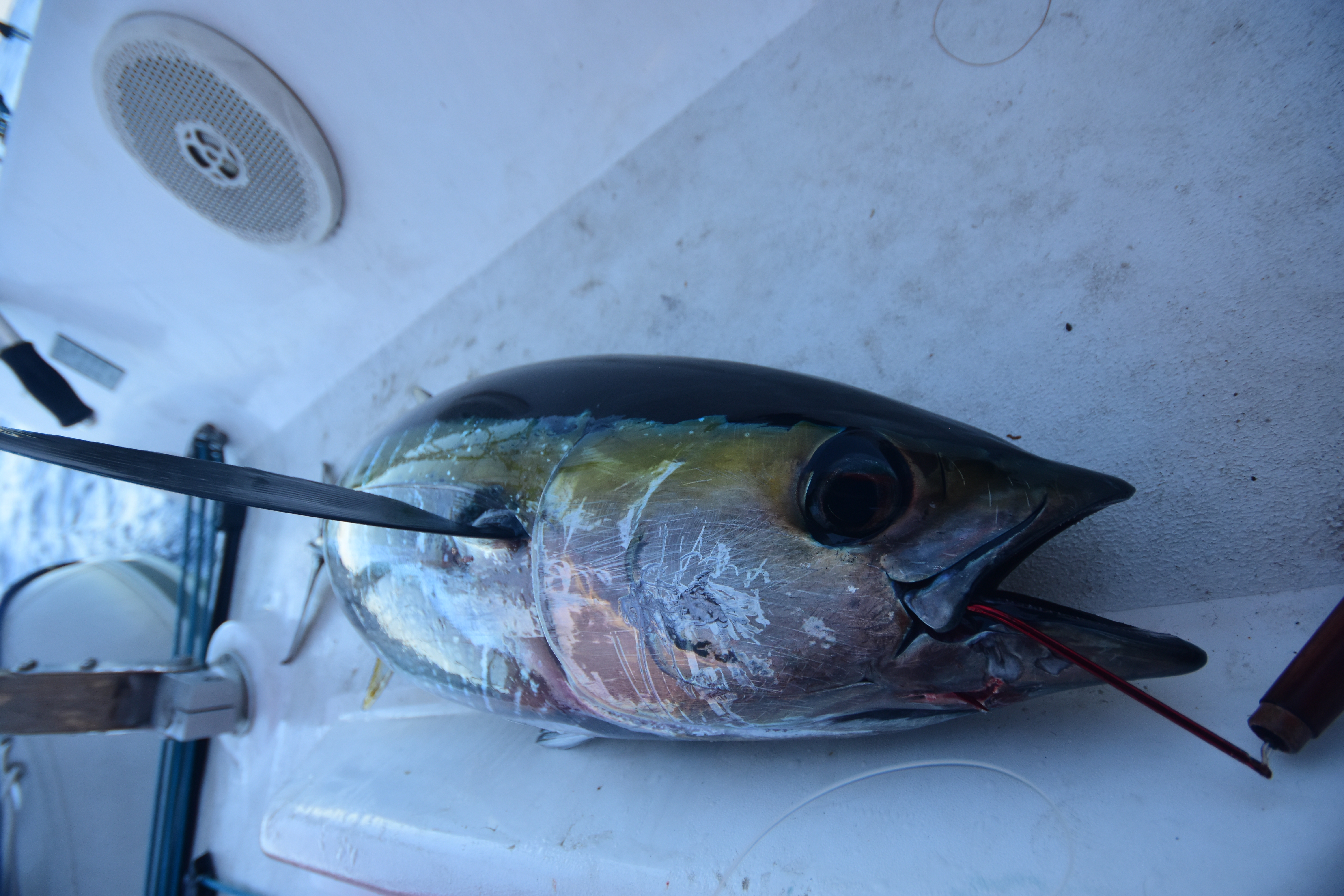
The next day we caught a tuna!  It was an Albacore tuna (you can tell by the super long pectoral fins and the big eye) and it was pretty delicious.  We froze a lot of it and ate it over the next several days.
It took us two nights to get to Punta Baja, where we anchored and spent a night.  During the night I played around with my camera a bit and did some longer exposures...

From Punta Baja we sailed on south, but the wind was pretty light and I had discovered that we burned a lot more fuel motoring that I had figured, (and our tanks were getting low) so we did a short hop to Punta San Carlos, where I had been before with the truck and surfed.  The waves were big out at sea and didn't disappoint, I had an evening and morning of great surf (head high) at that point.  After leaving in the morning we tried hard to make it to Islas San Benitos, but didn't arrive until 1 am, and the charts are pretty sparse around there, so coming in at night was challenging.  The next day, the wind finally arrived, but from the south.  So we sailed upwind (but only on one tack, we could just barely point at the place we were trying to go), and found some Gray Whales...

And then we got into Bahia Tortuga.  That is about halfway down Baja, and we stayed two extra days waiting for the wind to die down.  There was a pretty big storm that made the wind blow from the south up to about 30 kts (that we measured on the anemometer) with some gusts above that.  Strong enough to make nasty waves that we were able to hide out from.  While we waited, we saw some Brants!

They were hiding as well.  Then we went over to town and got some fuel (which is a task, going ashore through the break, then walking up to the gas station, then lugging the jugs back, then doing it again)  On the second return to the boat my phone jumped out of my pocket into the surf, and tried to burrow into the sand.  I fished it out and got it working again for a little bit, but it died a day later.  I believe the cause of death was corrosion by drowning.  So I switched the sim card to my old mexican phone, and it is working, sort of, but much harder to use.  The list of things to fix grows!  From there, we sailed to Bahia Ascencion, and raced two other sailboats who were leaving at the same time.  It was a close race when there wasn't any wind and we were motoring, but at 1 pm, the wind came up and we began to roll along at 8 kts, and that was that.  In between Bahia Tortuga and Ascencion, there is a line where the kelp stops growing at, and that marks the end of the "California" waters.  It began to grow warmer, and there was different fish.  Also the area south of the Tortuga is more sheltered from the NW swell, so it feels great. 
We also saw some little murrelets, which I couldn't identify exactly.  
And we saw our last Albatross.  A Laysan Albatross!  
From Ascencion we were going to continue sailing along the coast and point hopping, but the wind was great and so we just went for it, doing an overnight to Bahia Maria (near Bahia Magdelena).
  We spent one day in Bahia Maria, and hiked up the hill overlooking the point.  I've done this hike a few times before, and its great.  I surfed a bit and then came back for a nap in the afternoon, and then we left in the evening, because the wind was forecast to be good for only a few more days.  
But the wind was really good.  We took off into the darkness doing 9-10 kts, and it felt really good.  The wind began to shift a little around midnight, and the next dawn we found ourselves even with Cabo san Lucas and about 150 miles west.  (The boat doesn't like to go directly downwind)  So we jibed and headed for Isla Isabel.  From that point we had about 350 miles to go to Isabel, and we covered that distance in two days.  A midnight to Midnight run of 198 miles during one of those.  
It was dawn when we arrived, and the birds were swarming over a school of fish.  Crossing the Sea of Cortes was pretty rough for us, so we were glad to get in and sleep. 
But also to explore!  We went ashore and searched out some birds.  This is my favorite island around here and we walked under the trees with Frigatebirds all over clacking and croaking and flapping.  It really makes you feel like you've gone back in time.
Of course we spent some time looking at the Blue-Footed Boobies, and they were dancing a little bit.
I got some shots of a frigate from close up
The feathers are a bit worn down on this guy.
But his eye is very bright.
Also the Brown Boobies were nesting too.

From there we did a single day hop to Punta Mita and have had a few nights of sleep and some surf.  It feels good to be here.  Like being home.
I've discovered some problems, however.  The main battery bank is not working very well.  I have the solar panels charging all day long and then its dead at night.  So I think I need to replace the batteries.  Also the Mainsail is falling apart every time I use it.  But at anchor she feels great, and the dinghy davit system is awesome.  So I'm pretty darn happy with the boat so far.


Wednesday, December 23, 2020

My Dreamboat!

I'm living on water again!  After being a land lubber for about two weeks, (once I sold Layla) I bought another boat.  This one is the one I've been dreaming about for years and years, it is a Pogo 40.  I went sailing on this boat (and made videos) twice over the past few years, and I really liked it.  So the first thing that I did is modify it...  I added an arch over the stern to hold the Dinghy up, and so now I have a dinghy that sits just above the water while sailing and is partly balanced on a small swim step on the back of the boat.  It works out quite well, actually.  I was able to deploy the dinghy while sailing at about 3 knots without any trouble, and also to lift it again without slowing down.  Here's a picture of it while heeled over in some wind.
Abe came down and we went on a trip out to Catalina Island and Santa Barbara Island, and we found a Jaeger,
And here's Aquila (the pogo's name) anchored out.  I've added solar panels on top of the dinghy rack.  Also I've got the Staysail, the jib and the code 0 (a spinnaker) set up at the same time.  Its nice having a few options to roll out.
We zipped around Santa Barbara Island and found some young Sea Lions, and they were curious, so came close.  This picture shows the weird eye membrane (is it nictitating?)  that covers their eyes.
Another, and here the eye is very different, but still no easily discernable pupil.
Here's Aquila anchored out again
And some cacti we came across on the island
On these islands there is this kind of small tree that I really like, but I don't know the type, and here they look like they are walking up the hill.
And here is a horned lark
A shot under sail.  Because the dinghy is so easy to deploy, I just popped out on it while sailing (abe was still on the boat) to do some photos and video.  
And a look up, surrounded by sails.
So this is the dream boat of mine.  I'm trying to build it into a fast cruiser, and do lots of big voyages aboard.  I'm still in the testing phase and there are a lot of things I'll be working on and changing, of course, but I've got a start.  Its great to be living on water again.
 

Saturday, November 21, 2020

Rocket Launch!

I watched a rocket launch today!  It had been a while since the last one, the Space Shuttle, back in 2008.  This rocket is much smaller, but still really cool.  It launched from Vandenberg Air Force Base, on the sort of western middle area between San Francisco and Los Angeles.  The coolest thing about this launch is the rocket bottom part (the booster) comes back and lands!  So it launched in the middle of the morning, and there were tons of people watching.  The actual start is behind a hill, but it popped up over the hill with a bright blazing pillar of fire underneath and everyone started cheering.  I took some shots early, but the exposure was wrong.  So by the time I got the camera set up correctly, it was up a ways, and the first shot (above, its going about 600 mph and about 10,000 ft, I think.
Then it passed through a layer of different air where it began to make a cloud behind it, and this was also around the time of max Q, which is when the air is pushing on it the hardest.  As it goes faster there is more air pushing on it but as it goes higher there is less air.  At some point it has a maximum of air it pushes against, and this is that point.  After this, it becomes easier to push, until it gets into "no air at all" or what you might call... SPACE!  The rocket is still going very vertical, and it was really cool to see the vapor cloud make a shadow through the air. 
This shot is a little later on, when the rocket is much higher.  If you compare this to the first shot, you will see the exhaust doesn't go straight down anymore, but puffs out a ways before going down.  It looks rounded and wider.  This is because the engines try to push the exhaust straight down, but they try to match the sideways pressure, sideways from the exhaust plume direction, and that pressure at sea level is higher, but at this height is much lower.  So the plume can expand now but earlier could not.  This means the engine isn't as efficient now.  Which is one of the reasons to use stages: to stack a rocket on top of another rocket.  The second stage has an engine that works better way high up.
This shot you probably have to click on it to see closely, but the stages have separated, and the booster is doing a return to launch pad burn.  So the booster went up, then comes down, but since it also went sideways a bit (since the satellite wants to orbit the earth, which means going fast sideways), it has to cancel that sideways motion.  I was expecting it to turn exactly 180 degrees and burn straight back.   But it didn't do that!  I was totally stunned, and it took me a while to figure it out.  Here's what happened:  The booster started due west of me, and headed southeast.  When it shut off, it was about due south of me.  The turn around burn pointed north, towards me.  So if you start on the earth and go southeast and then north, do you arrive in the same location?  The answer is yes, if you go up!  Since the earth is turning, and rotating to the east (you are going east right now), if the rocket went straight up, it would end up west of the spot it started.  So this rocket looked like it was going in a triangle, but the actual trajectory is more like a rounded curve (looking from the above view), and as it came down, the landing pad moved over to catch it.  Luckily, the earth was moving fast enough to catch the rocket perfectly.  
In this shot you can see the rocket is coming down at an angle.  This is a way of steering, and making it so it doesn't have to burn as much fuel to still make it back to the landing pad.  I think that's cool.  Also its doing a re-entry burn, which is to slow it down just as it is coming back into the thicker atmosphere.  Because it was falling, it got going really fast, and would burn up if it didn't slow down now.  Sort of like jumping out of an airplane, falling really fast, but then popping a parachute so you don't hit the ground so fast.  Except the rocket is still going really fast after this burn, so it did another burn at the end.
The landing burn!  I didn't get to see the legs deploy, because it was behind the hill, but they come out next and it lands.  Do you see the difference in color of the sky here vs the ones above?  Its the same exposure, but there's just more air!  Also, you can see the exhaust plume is very thin again, indicating lots of pressure around the rocket.

Then I went for a walk on the beach (that had been closed before for safety) and I saw the booster on the landing pad with a crane about to get it stowed away.  Its amazing how big these things are.
On that same beach there were some Snowy Plovers!  This one was very cute.
And I really like the succulent plants on the beaches here.  These reminded me of a rocket launch with the fiery burning colors, like pillars of flame!
 

Monday, November 9, 2020

Layla is sold, southbound!

I sold my Layla!  She treated me well, and I took her 4,000 miles this summer and had great adventures aboard her.  The guy I sold her to is going to take her up the inside passage to Alaska next summer, so I hope he has a great time.  I'm going to be driving south, and just how far south, I don't know yet.  I'd like to go and surf in Mexico, but I'm not sure about the border.  And I'd like to go south to buy the Pogo 40 that is in LA, but we have to figure out the details.  Hopefully I won't be without a boat for too long.  So I can be living the Life on Water again soon.  


Monday, October 19, 2020

The summer on Layla


Here's a video of the summer on Layla.  

Tuesday, September 15, 2020

Back in Bellingham

I made it back to Bellingham!  My trip through Alaska was actually more difficult than the trip through Canada.  The wind was blowing from the south the whole way through Alaska so it was slow going.  I also didn't have an autopilot for the entire trip, since it broke on my way up to Juneau, so I was chained to the wheel the whole time.  It wasn't the end of the world, but in the future for a long trip I would rather have some way of not having to steer the whole time.  So I left Ketchikan and after crossing Dixon Entrance, I made my way into Prince Rupert to check in with customs, and they were quite reasonable and nice, so I continued on my way.  Upon entering Greenville Channel, I stopped in a place called Lowe Inlet and there was a waterfall with Coho Salmon jumping up it!  It was great, I paddled over and tried to get some video and pictures.  The salmon are pretty reckless, and they can't really see where they are going, so I ended up getting hit a few times by them as they jumped and I was right next to the falls.  I was surprised not to see bears there catching fish in mid air.  Maybe they don't know how to do it here.  After Lowe Inlet, I caught lots of great current, where in the morning it would be high tide, and I would be in the middle of a long passageway, so the current would help me go "out" and then it would be noon, and I would catch the current "in" the next passageway.  I did this for a few days and it worked great.  I also started catching winds from the north, (and some sun!) which really helped too.  I could fly the spinnaker, and a few times I was holding speeds of over 8 knots.   In one of these places, I passed the quintessential Canadian navigation marker: 
Eh?   And here is a picture of the spinnaker that earned me so many miles:
When I got across Queen Charlotte Entrance (the north end of Vancouver Island), the winds lightened and the wildlife suddenly came out!  I saw some Orca,
An Elephant Seal,
And Dall's Porpoises and Pacific Whitesided Dolphins.  I also found a bunch of Humpback Whales just north of the San Juan Islands, in the middle of the Strait of Georgia.  I hadn't seen them much down here, so that was a nice sight.  Upon getting close to the border, however, it began to get gloomy.  The smoke from all the fires soured the sky and I met up with my friend Danny in the San Juans and he took this picture of Layla in the smoke.  
Pretty nasty, huh?  So I made it through Canada in 10 days, and Ketchikan to Bellingham in 12.  Thats pretty quick.  Now I'm trying to get settled into Fairhaven and get the boat in better order again for the winter.